The Smart Packer is not affiliated with or endorsed by the National Park Service.
Direct answer: For most national park trips, pack your entrance pass or reservation with photo ID, layers for sudden weather changes, a day pack built around the Ten Essentials, plenty of water, sun protection, an offline map, and a basic car kit. Every park has its own rules, so check the park website before you go.
You won't forget anything because I won't let you.
Do you need a park pass or reservation?
The National Park Service says most of its sites are free to visit, but some require an entrance pass, and you may need a reservation at a few high-traffic sites. For parks that charge a fee, its passes page lists a standard pass for one park for 1 to 7 days, an annual pass for one park or park group, and the America the Beautiful pass, which covers entrance fees and standard amenity fees at federal recreational sites, including national parks.
As of the October 9, 2026 update of that page, NPS lists the Resident Annual Pass at $80 for US citizens and residents and the Non-Resident Annual Pass at $250. It also lists a $100 nonresident fee for nonresidents age 16 and older at 11 named parks, unless they are admitted with an annual or America the Beautiful pass. Passholders must show valid photo ID with each pass, so pack the pass and the ID together. Prices change, so confirm on the entrance fees by park page.
Reservations work differently. NPS says some parks use timed entry to manage vehicle traffic and others use tour reservations, usually released on Recreation.gov on a rolling basis, and it recommends booking well in advance. Rules change by park and season, so check the NPS parks with reservations list, then save or print your confirmation in case you lose signal at the gate.
How should you layer for elevation and weather changes?
Weather can change fast in a park, especially if your day climbs from a valley to a high viewpoint. The NPS Ten Essentials guidance says to prepare for sudden changes in weather and to pack an extra layer that reflects the most extreme conditions you could encounter, such as a raincoat, jacket, hat, or gloves. It also suggests bright clothing so Search and Rescue can see you more easily.
Check the park weather for every stop on your route, then dress for the coldest one. A simple layer system covers most trips:
- A base layer that dries quickly
- A warm mid layer, such as fleece or a light puffy jacket
- A rain shell
- A warm hat and light gloves for high viewpoints
- Broken-in walking or hiking shoes
Packing cubes keep each traveler's layers easy to find in the trunk ( Compression Packing Cubes). Visiting in snow season? The winter camping packing list covers cold-weather gear in more depth.
What goes in a national park day pack?
NPS recommends packing the Ten Essentials, a set of basic items that can help you or others if there is a minor injury, a sudden weather change, or an unexpected emergency. NPS groups them into ten categories:
- Navigation: map, compass, and GPS
- Sun protection: sunglasses, sunscreen, and hat
- Extra clothing: jacket, hat, gloves, rain shell, and other layers
- Illumination: flashlight or headlamp, with extra batteries
- First-aid supplies, including any personal medications
- Fire: matches or a lighter and fire starters, used only where park rules allow
- Repair kit and tools: duct tape, knife or multi-tool, and scissors
- Nutrition: extra food
- Hydration: water and water treatment supplies
- Emergency shelter: tent, space blanket, tarp, or bivy
On water, NPS says that if you are active outdoors, especially in hot weather, you should drink water often and before you feel thirsty, and prepare your water before you need it. Carry a refillable bottle for each person, find out where water is available on your route, and bring treatment supplies if you plan to collect water. For sun, NPS adds that sun-protection clothing such as pants and long-sleeve shirts can help minimize exposure.
For short viewpoint stops, a small sling keeps your phone, park pass, and sunscreen reachable ( Crossbody Sling Bag). For longer trails, our hiking trip packing list has the full day-hike kit.

What should you keep in the car?
Park roads can be long, and services can be far apart. Fill the tank and charge your devices before you lose signal, and keep a car kit in the trunk:
- Extra water and snacks for everyone in the car
- A spare warm layer and rain jacket per person
- First-aid kit
- Flashlight or headlamp
- Phone charger and cable
- Printed directions or a downloaded map
- Trash bags for packing out garbage
- Wipes and paper towels
NPS also asks drivers to follow speed limits, watch for wildlife on the road, and pull completely off the road into a designated pull-out to watch animals ( NPS wildlife safety tips). Our road trip packing list covers the rest of the drive.
How do you navigate without cell service?
Download maps before you leave signal. The official NPS App has interactive maps, and NPS says you can download content from entire parks for offline use. The Ten Essentials guidance also says to bring a physical map as a backup and pack an extra battery for your phone.
A power bank works well as that extra battery. If you fly to the park, TSA says power banks must go in carry-on bags, never checked bags.
How close can you get to wildlife?
Not close. NPS says many parks require you to stay at least 25 yards from most wildlife and 100 yards from predators like bears and wolves, and that viewing distances vary by park. It also says that if you are close enough for a selfie, you are definitely too close. Check your park's rules on its website, in the NPS App, or with a ranger ( 7 ways to safely watch wildlife).
NPS adds that it is illegal to feed, touch, tease, frighten, or intentionally disturb wildlife, and that you should store food and trash in wildlife-resistant containers where they are available or required. So pack binoculars or a zoom lens for viewing, and sealable food storage and trash bags for the car and campsite.
How do you follow Leave No Trace in a national park?
NPS summarizes the Leave No Trace Seven Principles: plan ahead and prepare, travel and camp on durable surfaces, dispose of waste properly, leave what you find, minimize campfire impacts, respect wildlife, and be considerate of other visitors.
For packing, that means a trash bag for everything you bring in, food repackaged to cut waste, and a way to pack out toilet paper and hygiene products. Camping overnight? Use the camping packing list for shelter and kitchen gear.
National park packing checklist
- Entrance pass or reservation confirmation, saved offline or printed
- Photo ID for the pass holder
- Base layer, warm mid layer, and rain shell
- Warm hat and light gloves
- Broken-in walking or hiking shoes
- Day pack with the Ten Essentials
- Refillable water bottle for each person
- Sunglasses, sunscreen, and sun hat
- Headlamp or flashlight with extra batteries
- First-aid kit and personal medications
- Offline maps in the NPS App plus a paper map
- Power bank (carry-on only if you fly)
- Binoculars or a zoom lens
- Trash bags and sealable food storage
- Car kit: extra water, snacks, charger, wipes
- Packing cubes

Crossbody Sling Bag (Black)
Zippered crossbody sling for a phone, park pass, and sunscreen on viewpoint stops.
From our shop: we sell this product and earn from purchases.
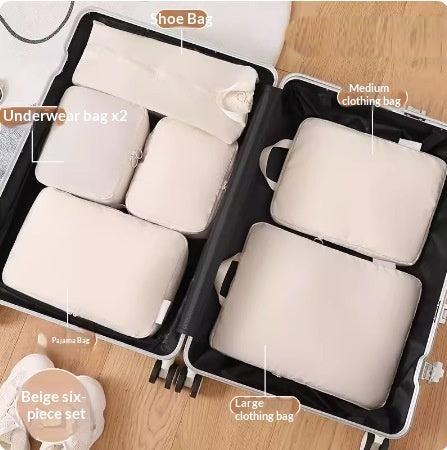
Compression Packing Cubes, 6-Piece Set (Beige)
Six zippered cubes that keep trail layers and dusty clothes sorted away from clean clothes.
From our shop: we sell this product and earn from purchases.
National park packing FAQ
What should I pack for a national park trip?
Your entrance pass or reservation and photo ID, layers for fast weather changes, a day pack with the Ten Essentials, water, sun protection, an offline map, and a basic car kit. Check the park's own website for local rules.
Do I need a pass to visit a national park?
Not always. The National Park Service says most of its sites are free, but some require an entrance pass and a few high-traffic sites need a reservation. Check the park's fees and reservation pages before you go.
What are the Ten Essentials?
Navigation, sun protection, extra clothing, illumination, first-aid supplies, fire, a repair kit and tools, nutrition, hydration, and emergency shelter.
How far should I stay from wildlife in a national park?
The National Park Service says many parks require at least 25 yards from most wildlife and 100 yards from predators like bears and wolves, and that distances vary by park. Check the rules for your park.
Will my phone work in national parks?
Do not count on it. Download park content in the NPS App for offline use before you lose signal, and bring a physical map as a backup.